The single application through which a member holds, moves and participates across the SWSS ecosystem — one verified identity, one portfolio, and every product settling on the same layer rather than a separate account per product.
Verification is performed by the SWSS Identity Verification Layer, not by the application. The distinction matters to a member for a practical reason: you verify once, and the result travels with you across every SWSS property rather than being repeated per product.
Which Applies to You
| KYC | KYB | |
|---|---|---|
| Who it is for | An individual member | An institution, company or other legal entity |
| What is verified | That you are who you say you are | That the entity exists, and that the person acting is authorised to act for it |
| Typically requires | Government-issued identity documents and a liveness check | Entity registration records, beneficial ownership information, and evidence of the signer's authority |
| Reviewed | Largely automated, with review where required | Includes review that is not instantaneous. This is normal and is not an indication of a problem |
Both are initiated from Verify Identity in the application, which hands off to IVL and returns you when the process concludes.
What You Receive
The result of verification is not a flag set in the application's database. It is a credential issued through IVL and recorded on chain, and three properties follow from that:
- It is reusable. A verified member carries their status across every SWSS property rather than re-verifying per product. The whole ecosystem reads one credential.
- It is the Foundation's, not a vendor's. Verification is performed by providers admitted to the Foundation-governed IVL Provider Registry. The Foundation admits the provider; the provider performs the check; the credential is the Foundation's. If a provider is later removed from the registry, credentials already issued through it remain valid: only new issuance from that provider stops.
- It does not re-disclose your documents. The credential attests to your verified status. It is not a copy of the documents you submitted, and presenting it to a product does not present them. Where a record is commercially sensitive, zero-knowledge settlement allows validity to be proved without the contents being published: see SCP-ZK.
What Verification Unlocks
Operations that move value or settle a DEED-1 record require verification, because verified participation is enforced at the consensus layer rather than applied afterwards by an interface. An unverified account can be created and explored; it cannot settle. See Compliance at the Protocol Level.
Institutions should also read IVL Credential Types, which sets out the credential tiers, and Three-Tier Deed Access Architecture, which governs what a credential permits against a settlement record.
A credential can require renewal, and circumstances that change an entity's standing (a change of control, a change of jurisdiction, a lapsed registration) are matters an institution is expected to bring forward rather than wait to be asked about. Obligations attaching to a verified participant are set out in Developer Obligations and, for the legal framework, in the SwssChain Whitepaper.
Where This Happens in the Application
Account → Verify Identity. The screen states the standard your credential is issued against, the status of your verification, and what verifying unlocks.
Reading the Status
| Status | What it means |
|---|---|
| Not started | No verification has been submitted. The screen offers to begin one. |
| In progress | Submitted and being assessed. Nothing further is required of you while it sits here. |
| Approved | The credential is issued and travels with you across every SWSS property. |
| Rejected or expired | The screen states what to do next. A rejection is not final and does not close the account. |
identity --status
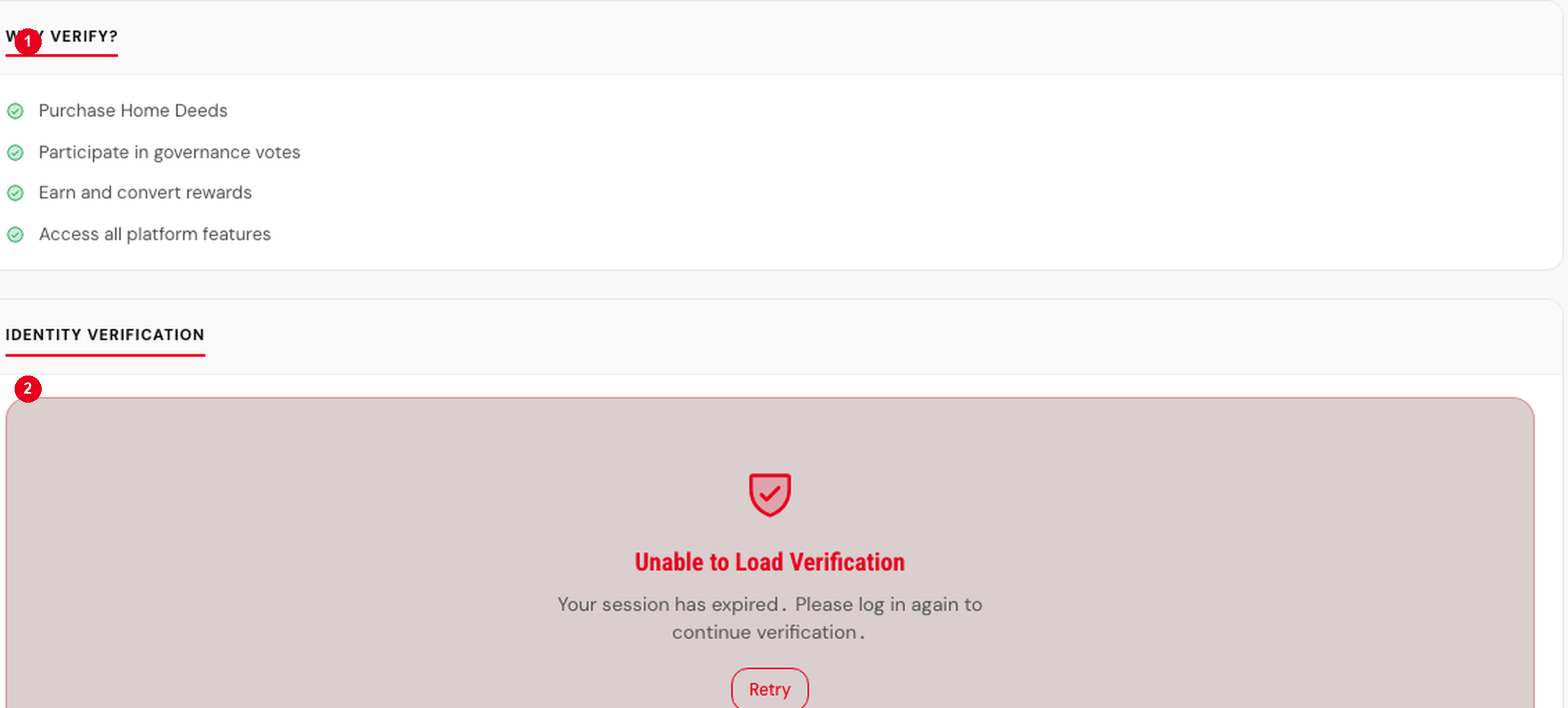
Pending recapture against the current interface.
- What an approved credential opens. Purchasing deeds, voting, and earning and converting rewards. It is checked at settlement rather than at the interface, which is why one credential works across the ecosystem.
- An expired session, and the retry beneath it. The verification session is short-lived by design. Retrying starts a fresh one: nothing you submitted is lost, and a lapse is not a rejection.
If the Screen Says Your Session Expired
Verification is performed by a provider admitted to the Foundation-governed registry, in a session opened for you. That session is short-lived by design. If it lapses before you finish, the screen offers to retry: sign in again and start it fresh. Nothing you submitted is lost by retrying, and a lapsed session is not a rejection.
What Verification Opens
An approved credential is what allows deeds to be purchased, governance to be voted in, and rewards to be earned and converted. It is checked at settlement rather than at the interface, which is why the same credential works across the ecosystem instead of once per product.